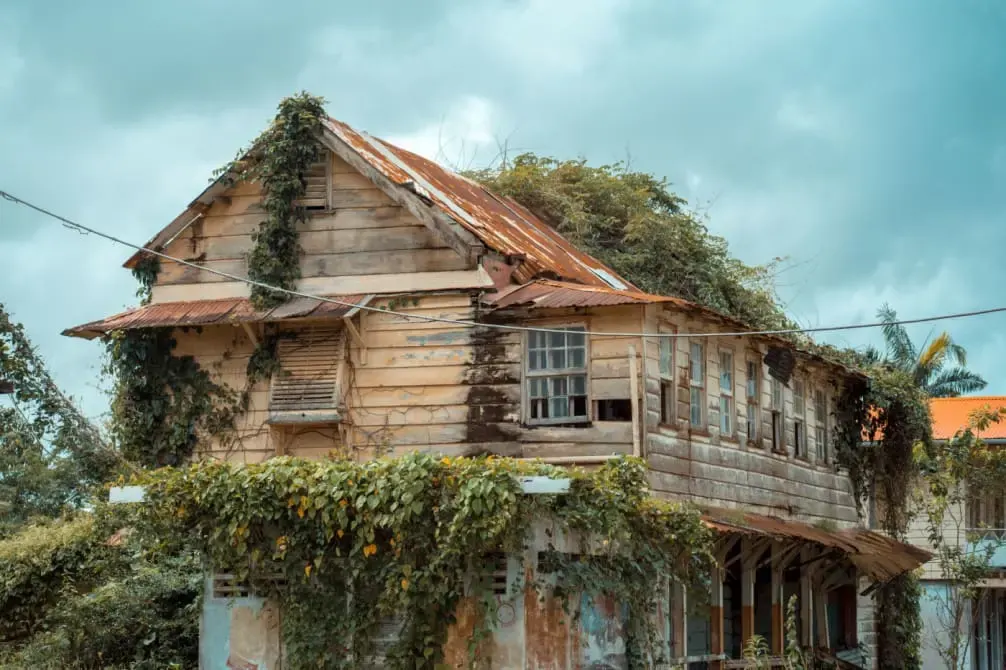
Somewhere along one of Bermuda’s winding roads, an old house sits behind a garden that has long since surrendered to the passing seasons. Its windows are closed, the paint has begun to fade, and whatever life once moved between its walls has grown quiet.
It is easy to imagine that there was a time when the house looked very different. Surly children hurried through its doorway on their way to school, family gathered around the dinner table, and someone stood at the window watching the rain beat across the garden. There must have been laughter, disagreements, celebrations and difficult decisions, all the ordinary moments that eventually become the history of a home.
Today, however, its quiet… nobody lives there.
Also Read: Africa and Caribbean Strengthen Fisheries Cooperation in New Agreement
Across Bermuda, residential properties have fallen into disrepair, some standing empty for years while families and communities grapple with questions of ownership, inheritance and what should happen next.
In a country where housing has become increasingly difficult to secure, those silent buildings are now part of a much larger conversation about the island’s future.
Abandoned Properties and the Bermuda Housing Crisis
According to figures cited in Bermuda’s proposed framework for derelict and abandoned properties, at least 290 residential units across 218 addresses have been formally identified as uninhabitable. The number may be higher, and not every property can necessarily be restored or made available for occupation.
But behind those figures lies an important question: could these neglected homes help ease Bermuda’s housing crisis?
The answer is far from straightforward, involving a complicated balance of property rights, family histories and financial realities.
A house may remain empty because its owner has died and the estate has never been settled. Perhaps the children have moved overseas, or several relatives have inherited a property without agreeing on what to do with it. Sometimes the problem is simply money. A roof begins to leak, repairs are delayed, and over time the cost of restoring the building grows beyond what the family can afford.
What was once a source of security becomes an increasingly difficult responsibility.
And still, selling the property or allowing someone else to take possession may be no simple decision.
For many families, a house is more than a financial asset. It is the place where parents raised their children, where grandparents spent their final years, or where a previous generation invested a lifetime of work in the hope of leaving something behind.
These attachments can survive long after the people who created them are gone.
Government Consultation on Derelict Properties in Bermuda
The Bermuda government is now considering how such properties might be brought back into use, having opened a public consultation on a proposed framework for derelict and abandoned homes.
The discussion includes possible assistance with inheritance disputes, mediation between property owners and financial incentives for rehabilitation. It also considers stronger interventions in exceptional circumstances, although no final decisions have been made.
The consultation has been extended until December 18.
At first glance, the reasoning behind the initiative may seems straightforward. If people need homes and existing buildings are standing unused, why not find a way to make those buildings habitable again?
But the answer becomes more complicated when ownership, family history and the rights of individuals enter the picture.
There are also historical sensitivities surrounding land ownership in Bermuda. Housing and Municipalities Minister Zane DeSilva acknowledged these concerns in Parliament on November 20, emphasising the importance of respecting property rights and avoiding the repetition of past injustices.
His remarks point to the delicate balance facing the government.
Balancing Property Rights and Community Needs in Bermuda
Leaving deteriorating buildings untouched can create problems for surrounding communities and contribute to the loss of potentially useful housing. But compelling families to surrender property without appropriate protections could create an entirely different set of grievances.
Somewhere between those concerns lies the possibility of a more constructive approach.
Perhaps the answer for one property is assistance with a long-unresolved estate. For another, it may be a financial arrangement that allows the owners to undertake repairs. Elsewhere, relatives might agree to sell, lease or restore a home once they understand the options available to them.
There will be properties that cannot reasonably be saved, and others whose owners have no interest in bringing them back into use. Bermuda’s housing difficulties will not disappear simply because some abandoned houses are restored.
Still, every building that can be returned to meaningful use represents an opportunity to preserve part of a neighbourhood while providing space for another chapter of life.
And this is not an unfamiliar story elsewhere in the Caribbean.
It is a peculiar thing about houses. They can outlive the people who built them, the circumstances that made them necessary and even the families who once gathered beneath their roofs.
But they cannot preserve themselves indefinitely.
As Bermuda considers what to do with its neglected properties, the challenge is not merely to determine how many buildings can be repaired. It is to find a way forward that recognises both the urgent need for housing and the complicated human histories attached to the places people call home.
Somewhere on the island, behind an overgrown garden and a set of shuttered windows, there is a house waiting for someone to decide what comes next.
And perhaps, with the right understanding and support, its story is not quite finished.